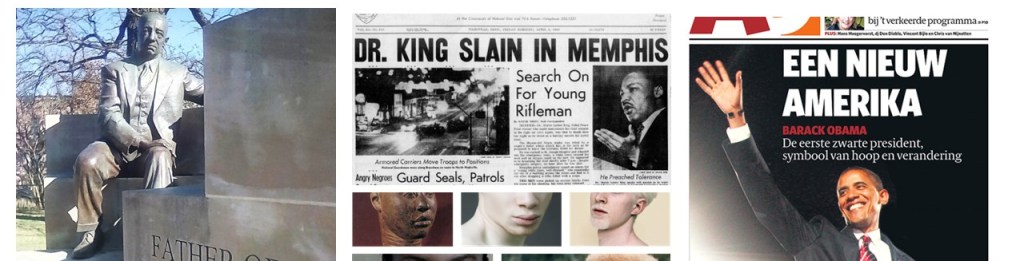
My timeline for denoting “New Americans” was the life of Rev. Dr Martin Luther King. “Old” Americans, like me, were those who remembered events of Rev. King’s lifetime that influenced the world through the end of the 20th Century. “New” Americans were those who learned of Rev. King mostly through documentaries and annual days off of school, emphasizing those born after 2008 and coming of age during the Presidents elected in 2016 and 2020.
The demarcation is was mostly to underscore why Obama’s election that seemed to be the manifestation of King’s dream has, in the eyes of many, become a retroactive nightmare. Lessons from “Black History,” I hoped, would provide tools to overcome current impasses.
I would love to say that there was universal impact with the class. But I encountered bureaucratic bumps I had not anticipated. Consequently, I only made three presentations of Part One. I chose to pull the project without continuing, for reasons to be outlined.
Nevertheless, while that door closed, other opportunities arose which led to this series. As with the classes, my premise and goal remain — to personalize the purpose of teaching “Negro” history as expressed by the Father of Black History, educator Dr. Carter G. Woodson, who wrote in 1926:
“We should emphasize not Negro History, but the Negro in history. What we need is not a history of selected races or nations, but the history of the world, void of national bias, race, hate, and religious prejudice.”
While these stories are based on the class outline, they’re not the course itself. This blog is memoirs involving “the Negro in history” as they affected my family, friends and experiences. The essays include perspectives I’ve gained during subsequent research and travels; plus commentaries on the changing political and cultural landscape about racial relations — in history and this morning.
Once aspect of the classes that I do include is an end-of-day query. Before the students left, I asked each to tell me or write down something they discovered during our time together that they did not know or understand when they entered the room. You’ll find such a question at the end of each essay. Your thoughts are welcomed. Just for sake of conversation.
A final reminder: while this series begins in “Black History Month” neither the stories nor reflections are confined for consumption during February. That includes quadrennial addition of February 29th.
My hope is that the accompanying tales do more than spark nostalgia, an occasional smile or even an “ouch.” My hope is that in sharing these talks of one Black man’s personal historical journeys, you’ll be able to discover your own history in the face of the American tapestry.
Are You Ready for the Question?
Is celebrating Black History Month necessary? Why or why not?

 Black History: A Personal Journey
Leave a comment