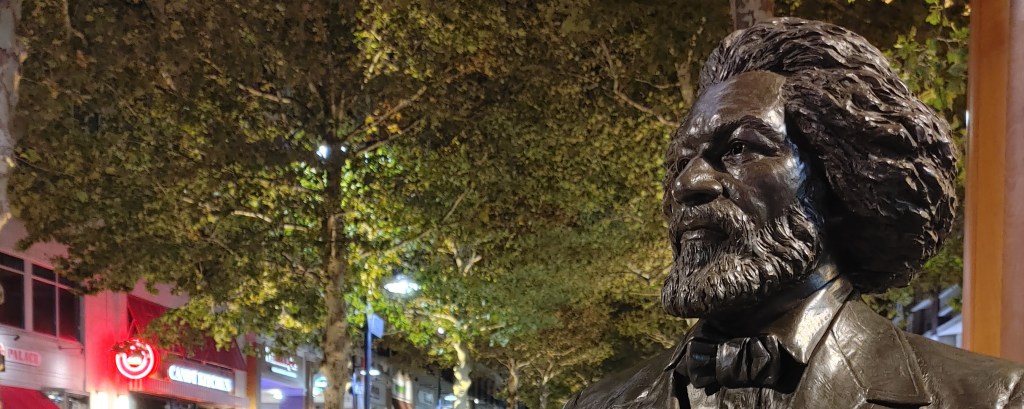
He was named Frederick Augustus Washington Bailey, perhaps born February 12, 1817 or ’18. He wasn’t sure for sure. “I have no accurate knowledge of my age, never having seen any authentic record containing it,” he wrote later. He did know his mother was a Black slave. He was not certain who his father was, but Douglass knew he was a white man, and likely the man who owned Frederick’s mother.
A theme song for his biopic could be, “Sometimes I feel like a motherless child.” As often happened in slavery, the mother was sent away after birth. “I do not recollect of ever seeing my mother by the light of day,” he wrote. “She was with me in the night. She would lie down with me, and get me to sleep, but long before I waked she was gone.”
Douglass chose February 14 as his birthdate remembering that his mother called him her “Little Valentine.”
Defying laws designed to keep Blacks illiterate, Douglass remembered alphabet and Bible reading lessons from his master’s wife until her husband convinced her to stop. He feared that a literate slave may run off or, worse, incite insurrection (as did Rev. Nat Turner in 1831), his master’s wife hid all literature. Douglass later taught himself to read and write by coaxing neighborhood White children to show him and by watching white men for whom he worked.
Becoming literate facilitated his escape, ability to select a new surname, and develop his gift as one of America’s most outspoken writers and orators. Douglass often called out the hypocrisy of national policies, politics and religion. His speeches and autobiographies were a template for radical commentaries from freed Blacks both before and after the Civil War, and such 20th Century leaders as Malcolm X and Rev. Dr. Martin Luther King Jr.
A frequent target of his criticism were professed believers in Christianity, the faith he boldly proclaimed, as did many of his abolitionist contemporaries such as Harriet Tubman and Sojourner Truth. As did King did a century later in his “Letter from a Birmingham Jail” and Malcolm X when rejecting his Christian roots to embrace Islam, Douglass lambasted vacillating Christian leaders.
That the quest for civil rights and justice by Douglass and his ilk was influenced by their response to Christianity underscores a matter educators, legislators, communities and families must recognize today:
It is impossible to correctly discuss Black History without discussing the role of negative and positive influences of Christianity from slavery through the Civil Rights Movement.
Douglass’ most notable in-your-face militancy occurred when he spoke at the 76th anniversary celebration of the Declaration of Independence in his adopted hometown, Rochester, NY, July 5, 1852. The speech, entitled “What is the Fourth of July to the Slave?” was shortly after Congress agreed to the Compromise of 1850. That law admitted California into the Union as free state and banned slave trading in Washington, D.C., while enabling the Fugitive Slave Act allowing that runaway slaves, or suspected freed blacks, to be captured and returned to slavery.
In the blistering speech, Douglass first blasts the descendants of the founding fathers for political malfeasance. He then turns on clergy.
“I take this law to be one of the grossest infringements of Christian Liberty, and, if the churches and ministers of our country were not stupidly blind, or most wickedly indifferent, they, too, would so regard it.
“At the very moment that they are thanking God for the enjoyment of civil and religious liberty, and for the right to worship God according to the dictates of their own consciences, they are utterly silent in respect to a law which robs religion of its chief significance, and makes it utterly worthless to a world lying in wickedness.
“The American church is guilty, when viewed in connection with what it is doing to uphold slavery; but it is superlatively guilty when viewed in connection with its ability to abolish slavery. The sin of which it is guilty is one of omission as well as of commission.”

 Black History: A Personal Journey
Leave a comment