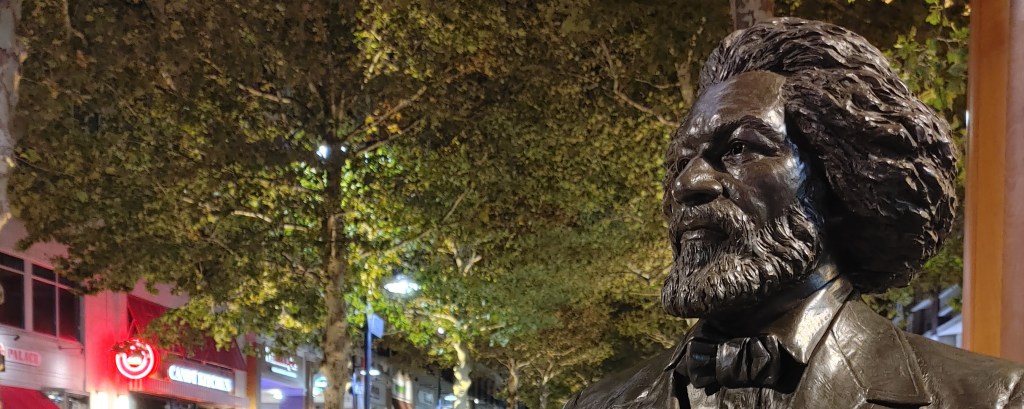
Douglass’ speech delivered 172 years ago retains views possibly applicable in today’s troubled times. One, a prophecy where church and politics comingle:
“Oh! be warned! be warned! a horrible reptile is coiled up in your nation’s bosom; the venomous creature is nursing at the tender breast of your youthful republic; for the love of God, tear away, and fling from you the hideous monster, and let the weight of twenty millions crush and destroy it forever!”
Another for those who believe Douglass’ criticisms of organizational hypocrisies applies to all Christians. To the contrary, Douglass made this point as he introduced individual pastors:
“In speaking of the American church, however, let it be distinctly understood that I mean the great mass of the religious organizations of our land. There are exceptions, and I thank God that there are.”
As Civil War was imminent, Douglass supported Lincoln’s election, but withdrew support for his re-election in 1864. He felt Lincoln’s timing and enforcement issuing the Emancipation was foot dragging. Nevertheless, while criticizing the late President at a ceremony dedicating an Emancipation Memorial in 1876, Douglass also lauded the complex 16th President for being a man of conviction.
“Though Mr. Lincoln shared the prejudices of his white fellow-countrymen against the Negro, it is hardly necessary to say that in his heart of hearts he loathed and hated slavery…”
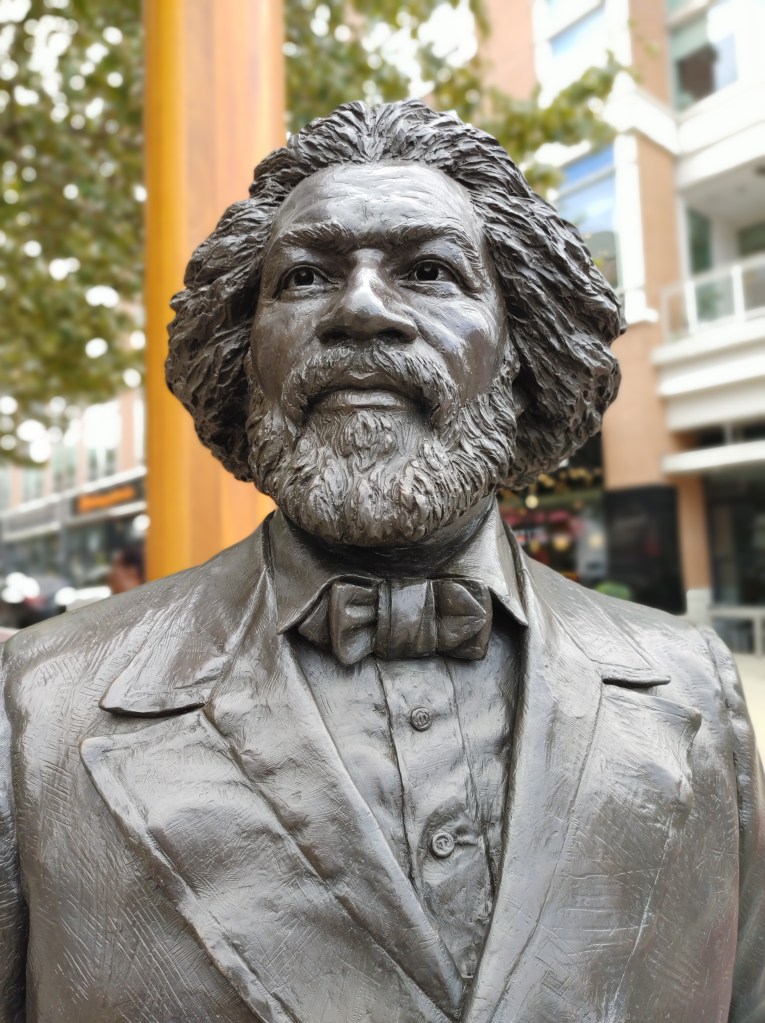
Like Lincoln, Douglass was complex. In his latter years, Douglass’ faith, family, and political relations were questioned by Whites and Blacks. Some called him a Socialist (he was not). A widower, he was criticized marrying a Caucasian woman as his second wife; for not agreeing with back-to-Africa or Black only towns in the U.S., for forgiving and reconciling with this owner, Thomas Auld, on the latter’s death bed.
Douglass’ complexity even took the shape of fiction: In the aftermath of police action shootings surrounding the death of George Floyd in 2020, monuments of Lincoln became targeted for protest or removal. A newsclip I saw of one such protest, a young Black woman seeming to want to damage the Lincoln Memorial in Washington encountered an actor portraying Frederick Douglass. While “Douglass” was trying to calm her down, the woman repeatedly yelled in his face: “Why are you protecting him? Why are you protecting him?”
Such an encounter illustrates reasons why studying Black History is essential across cultures without fear of indoctrination or assumptions based on current standards. It’s also why an important aspect of studying history, and conversing with others, is continuing to research past first glance. Illustration is Douglass’ July 4 speech in which he reprimanded American church leaders.
“Allow me to say, in conclusion, notwithstanding the dark picture I have this day presented of the state of the nation, I do not despair of this country. There are forces in operation, which must inevitably work the downfall of slavery. “The arm of the Lord is not shortened,” and the doom of slavery is certain. I, therefore, leave off where I began, with hope.”
Which begs this question as you pick Douglass’ 207th (or 206th) birthday card. Given the state of race relations today, what’s something from the life of Frederick Douglass which gives you hope?
Make a note of it on the “Thank You” card. Or send a Valentine.
Are You Ready for The Question?
Given the state of race relations today, what’s something from the life of Frederick Douglass which gives you hope?
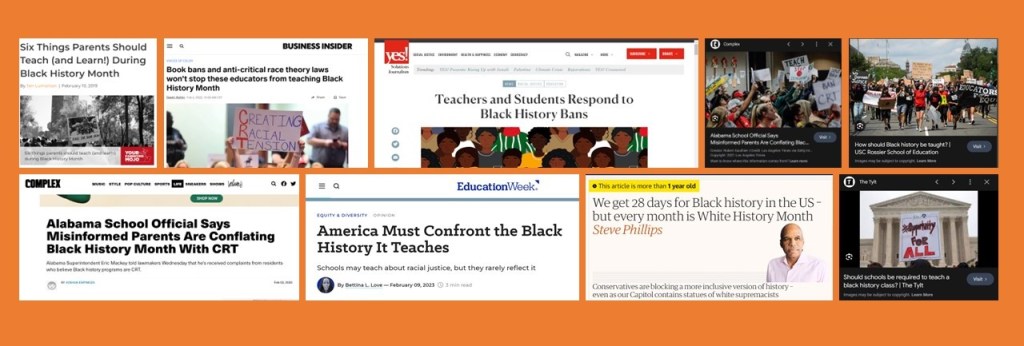

 Black History: A Personal Journey
Leave a comment